
If you’ve crossed 40 and suddenly need brighter light—or longer arms—to read small print, you’re not alone. This near-vision blur is called presbyopia, and it’s a normal, age-related change that affects virtually everyone.
Lately, many patients are asking an exciting question: can presbyopia eye drops replace reading glasses? Let’s unpack what these drops really do, who they help, and where glasses still win.
What Is Presbyopia?
Presbyopia occurs when the natural lens inside the eye gradually loses flexibility. This makes it harder to focus on near objects like phones, books, or menus. It usually begins around age 40 and progresses slowly with time.
Presbyopia is not an eye disease—it’s a natural aging process.
Traditional Ways to Manage Presbyopia
For years, the main solutions have been:
- Reading glasses
- Progressive or bifocal spectacles
- Multifocal contact lenses
- Surgical options (for selected patients)
These methods are effective, but many people want a glasses-free option, even if just for part of the day. That’s where presbyopia eye drops come in.
How Do Presbyopia Eye Drops Work?
Currently available presbyopia eye drops work by temporarily constricting the pupil (a process called miosis).
A smaller pupil creates a “pinhole effect”, similar to a camera aperture, which increases depth of focus and improves near and intermediate vision—without altering the eye’s structure.
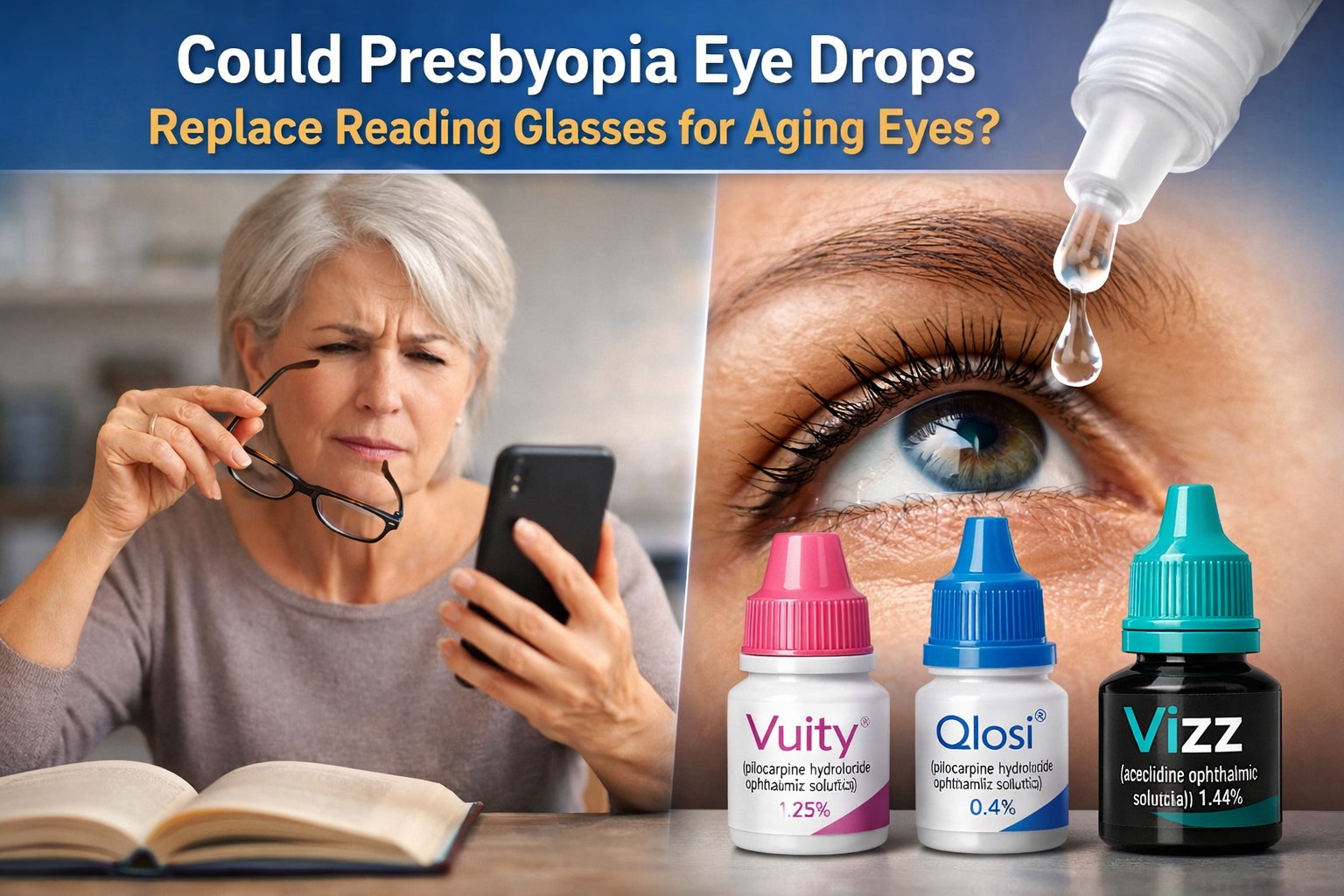
FDA-Approved Eye Drops for Presbyopia
These drops are prescription-only medications and should be used under professional guidance.
- Vuity® (AbbVie)
- Active ingredient: Pilocarpine 1.25%
- Dosing: Once daily (optional second dose after 3–6 hours)
- Effect duration: Up to 6 hours (up to 9 hours with a second dose in studies)
- Key benefit: First FDA-approved eye drop for presbyopia
- Qlosi™ (Orasis)
- Active ingredient: Pilocarpine 0.4%
- Dosing: Once or twice daily
- Effect duration: Up to 8 hours with two doses
- Key benefit: Preservative-free formulation
- Vizz™ (Lenz)
- Active ingredient: Aceclidine 1.44%
- Dosing: Once daily (two drops per eye, 2 minutes apart)
- Effect duration: Up to 10 hours
- Key benefit: Pupil-selective, with less impact on distance vision or ciliary muscle stimulation
Who Benefits Most From These Drops?
Presbyopia eye drops tend to work best for people who:
- Have mild to moderate presbyopia
- Have otherwise healthy eyes
- Want short-term near vision improvement for specific activities
- Prefer a non-surgical option
They may be less effective in advanced presbyopia or in the presence of cataracts or other eye conditions.
Important Considerations & Side Effects
While generally safe, these drops are still medications. Possible side effects include:
- Mild headaches or eye strain
- Redness or irritation
- Temporary dim or dark vision, especially in low light
- Difficulty with night driving due to smaller pupils
In rare cases, miotic drops may be associated with retinal tears or detachment, which is why a thorough eye and retinal examination is recommended before starting treatment.
Can Presbyopia Drops Fully Replace Reading Glasses?
Here’s the honest answer: for most people, no—at least not completely.
Presbyopia drops offer temporary visual enhancement, not a cure. They are best viewed as an alternative or supplement to reading glasses rather than a permanent replacement.
The Bottom Line
Presbyopia eye drops are an exciting advancement and can be a great option for selected patients seeking flexibility and convenience. However, reading glasses remain the most reliable, consistent, and cost-effective solution for many.
The key is choosing what’s right for your eyes—and that decision should always start with a comprehensive eye examination and professional advice.
Aging eyes are normal. Managing them smartly? That’s where expert eye care comes in