

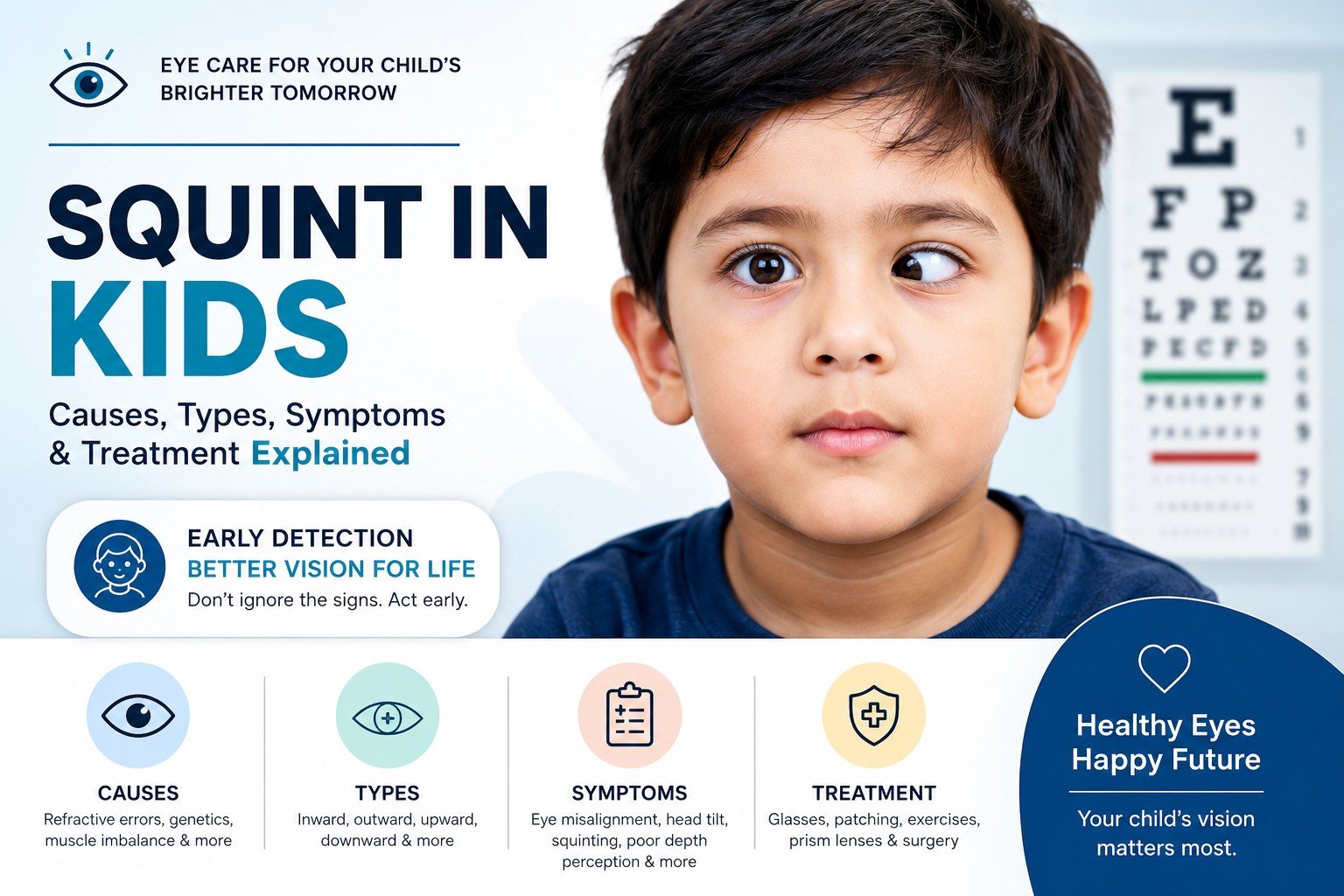
Squint in children—medically known as Strabismus—is a common eye condition where both eyes do not look in the same direction at the same time. One eye may turn inward, outward, upward, or downward while the other focuses straight ahead. It can appear intermittently or be constant, and early detection is key to preventing long-term vision issues.
What Causes Squint in Kids?
Squint can develop for several reasons, and in many children, it’s a mix of multiple factors:
- Refractive errors like long-sightedness (hyperopia) that force the eyes to over-focus
- Weak eye muscles or poor coordination between the brain and eyes
- Family history of squint or lazy eye
- Neurological conditions affecting eye movement control
- Birth-related or developmental issues
- Sometimes, no clear cause is found
When the brain struggles to align both eyes, it may “ignore” one eye—this can lead to lazy eye (amblyopia) if untreated.
Types of Squint
Squint isn’t one-size-fits-all. Common types include:
- Esotropia: Eye turns inward (most common in children)
- Exotropia: Eye turns outward, often noticeable when tired or daydreaming
- Hypertropia: One eye turns upward
- Hypotropia: One eye turns downward
- Intermittent squint: Appears only sometimes, especially during illness or fatigue
- Constant squint: Always present
Understanding the type helps guide treatment and urgency.
Symptoms Parents Should Watch For
Kids may not complain directly, so observation is key. Watch for:
- Eyes not moving together
- Frequent eye rubbing or blinking
- Head tilting or turning to focus
- Squinting or closing one eye in sunlight
- Poor depth perception (tripping, clumsiness)
- Complaints of double vision (in older kids)
Early signs are often subtle, so routine eye checks are important—even if everything “looks fine.”
Treatment Options
The good news? Squint is treatable, especially when caught early.
1. Glasses
If refractive error is the cause, corrective glasses can significantly improve alignment.
2. Patching Therapy
Covering the stronger eye helps train the weaker eye and prevents amblyopia.
3. Eye Exercises
In selected cases, exercises improve coordination and focusing ability.
4. Prism Lenses
Used to reduce double vision and improve alignment in mild cases.
5. Surgery
If non-surgical methods don’t fully correct alignment, eye muscle surgery may be recommended to realign the eyes.
Why Early Treatment Matters
Untreated squint doesn’t just affect appearance—it can permanently impact vision development. The brain may suppress input from one eye, leading to irreversible lazy eye and reduced depth perception.
The earlier treatment begins, the better the brain learns to use both eyes together—ideally before the age of 7–8 years, when visual development is most flexible.
Final Takeaway
Squint in children is common, treatable, and highly manageable when detected early. If you notice even subtle eye misalignment, don’t wait for it to “correct itself.” A simple eye exam can make a lifelong difference in your child’s vision.